ԼՐԱՏՎԱՄԻՋՈՑՆԵՐ
2026
Հունվար-հուլիս
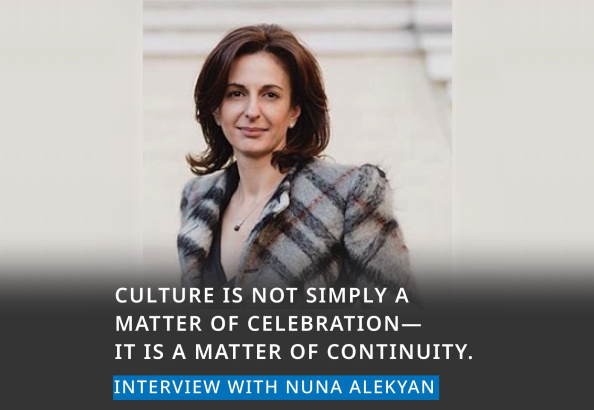
CULTURE IS NOT SIMPLY A MATTER OF CELEBRATION — IT IS A MATTER OF CONTINUITY.
Interview with Nuna Alekyan, a friend of the Primavera Charitable Foundation and Board Member at 301 Foundation, on the vital role of cultural initiatives in connecting the Armenian diaspora and sharing Armenian heritage with the world, and on the Together We Celebrate Armenian Culture & Spirit concert in London.
- In today’s global context, why is it crucial to make Armenian heritage visible and present beyond Armenia’s borders?
In today’s increasingly interconnected yet fragmented world, culture is not simply a matter of celebration—it is a matter of continuity. For a nation such as Armenia, whose historical experience has so often required its culture to survive beyond the protection of statehood, the international presence of its heritage becomes an essential form of resilience.
The word of Maestro Petrenko carries great influence. It would be truly wonderful if young British composers were inspired to attend the Maestro’s Academy this summer in Armenia, deepening artistic exchange and fostering new cultural bridges between our societies.
Introducing Armenian culture to the British public—and indeed to other global audiences—ensures that Armenia is known not solely through the prism of geopolitics and tragedy, but through its contributions to world civilisation: its music, literature, spiritual traditions, architecture, and philosophical outlook. This kind of cultural diplomacy fosters recognition, empathy, and intellectual curiosity.
- What is your impression of the concert Together We Celebrate Armenian Culture & Spirit at Saint Yeghiche Armenian Church in London?
The Together We Celebrate Armenian Culture & Spirit concert at St Yeghiche Armenian Church was a deeply moving occasion, filled with kindness, warmth, joy, and humility—not only for the Armenian community in the United Kingdom, but equally for our British guests who joined us in such encouraging numbers.
I wholeheartedly congratulate the team of the Primavera Foundation for their excellence and professionalism in all that they do. It is an honour to support their work and the important cultural mission they continue to advance.
What made this evening particularly special was the atmosphere of shared discovery. For many members of the British public present, this was a first encounter with the depth, subtlety, and emotional register of Armenian sacred and classical cultural expression. The fact that St Yeghiche—a spiritual and architectural landmark of the Armenian presence in London—became a space of intercultural dialogue for an evening reflects the very best of what Armenian cultural life can offer.
At a time when cultural understanding is too often mediated through politics or crisis, this concert allowed Armenia to be encountered through its civilisational voice: music, spirit, and artistic continuity. It was heartening to witness so many British attendees engaging with Armenian heritage not as distant observers, but as participants in a shared cultural experience.
- How do cultural initiatives abroad strengthen the Armenian diaspora and deepen its connection to Armenian identity and heritage?
Cultural initiatives such as the concert play a vital role in sustaining the Armenian diaspora’s living connection to its identity and heritage—particularly for communities several generations removed from Armenia itself.
Events held in culturally respected settings such as St Yeghiche Church do more than preserve tradition; they actively transmit it. They create opportunities for younger members of the diaspora to experience Armenian culture not as an abstract inheritance, but as a vibrant and contemporary presence within their everyday British environment. It was also a particular source of pride for our diaspora community to witness the remarkable talent of young and gifted Armenian musicians, whose performances were a true inspiration.
I would also like to extend my sincere thanks to Bishop Hovakim, as well as to the trustees and colleagues of the St Yeghiche Trust, for welcoming us all so generously and for opening their wonderful church so unreservedly to the wider public.
At the same time, when these initiatives are open to the wider public—as this concert so successfully was—they transform culture from an inward-looking exercise into a shared civic offering. This outward engagement strengthens the Armenian community’s sense of belonging within British society while maintaining its distinct cultural voice.
For those of us committed to advancing Armenia’s long-term cultural and civilisational security, such initiatives are indispensable. They nurture informed cultural ambassadors who can articulate Armenian identity confidently in an international context, ensuring that Armenia’s heritage continues to be recognised, understood, and valued far beyond its borders.
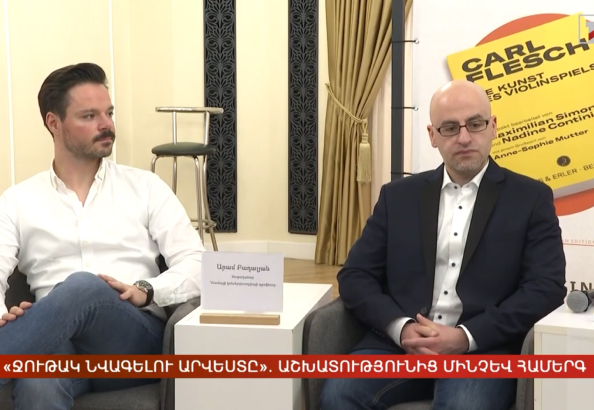
1st ARMENIAN PUBLIC TV: For the first time in the history of Armenian performing arts, Carl Flesch’s monumental and groundbreaking work “The Art of Playing the Violin” has been translated into Armenian
For generations, this legendary violin manual shaped musicians worldwide but remained beyond reach for Armenian students in their own language. Now it opens a bridge between global tradition and local heritage, marking a new chapter for Armenia’s young violinists.
Watch the full video here
2025
Օգոստոս-դեկտեմբեր
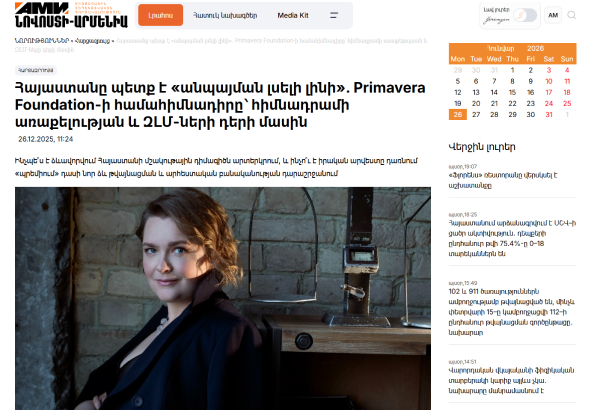
News Armenia: Interview with Elena Yakovleva
NOVOSTI–ARMENIA: “How is Armenia’s cultural profile being shaped abroad, and why is real art becoming a new form of “premium” in the era of digitalization and artificial intelligence?”
Novosti–Armenia interviewed Elena Yakovleva, co-founder of the Primavera Foundation of Armenia, about the importance of authentic, human-created art in today’s digital world. The interview also highlights the Foundation’s cultural and educational projects, including international collaborations and local events that strengthen Armenia’s cultural life.
Read the full Article here
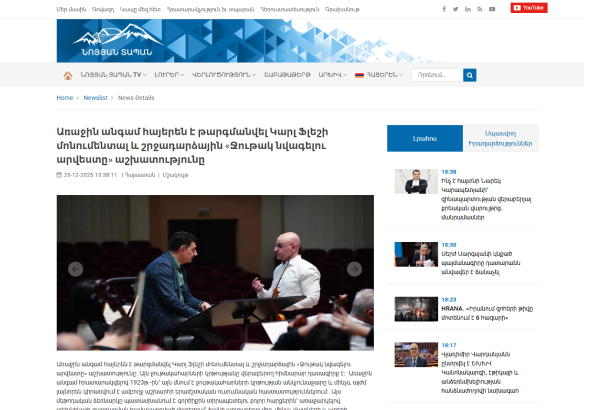
NOYAN TAPAN: Carl Flesch’s The Art of Violin Playing — now in Armenian
Carl Flesch’s legendary The Art of Violin Playing has now been translated into Armenian, a major milestone for music education in the country. Elena Yakovleva thanked the sponsors, noting that this ambitious project would not have been possible without them. Over seven months, 20 specialists worked to produce the Armenian edition, initially released in 300 copies, with more planned.
Professor Aram Badalian noted : “I devoted months to this translation, and the result was worth every effort.”
Keep reading here
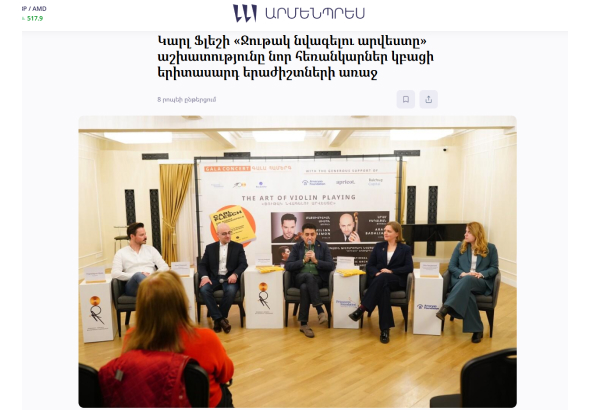
ARMENPRESS: First published in 1923 and still the cornerstone of violin education worldwide, Carl Flesch’s The Art of Playing the Violin is now available in Armenian
This manual offers a systematic approach to violin mastery, from technique and sound to psychological readiness, helping advanced students and professionals reach a higher level. The publication is part of an educational initiative by the Primavera Foundation of Armenia with the Armenian National Philharmonic Orchestra to strengthen music education across Armenia.
Discover more here
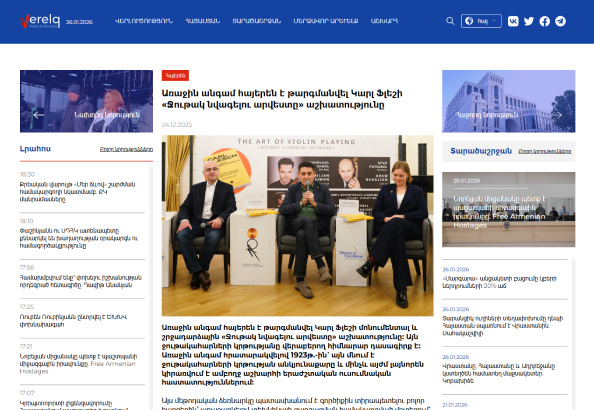
VERELQ: The Armenian-translated version of the manual “The Art of Playing the Violin” will be provided free of charge to conservatories, music colleges and schools in Armenia
The 2020 German edition of The Art of Violin Playing was edited by Maximilian Simon and Nadine Contini. The Armenian translation was carried out and overseen by violinist and Detmold Conservatory professor Aram Badalian.
Published under a licensing agreement with Berlin’s Ries & Erler, this landmark project was realized by the Primavera Foundation of Armenia in collaboration with the Armenian National Philharmonic Orchestra, with financial support from the Amaryan Foundation, Apricot Capital, and Balchug Capital.
Learn more here
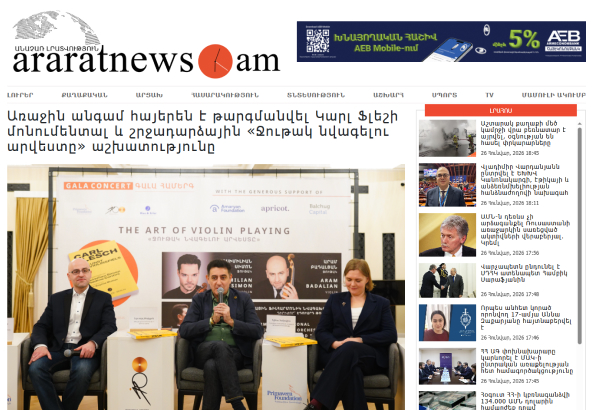
ARARAT NEWS: Armenian Translation of Flesch’s Violin Masterpiece Completed After Seven Months of Expert Work
Publishing the Armenian translation of Carl Flesch’s The Art of Violin Playing was a massive undertaking, completed over seven months by a team of 20 experts. The initial print run includes 300 copies, with additional editions planned in collaboration with the German publisher. Aram Badalian explained that the greatest challenge was conveying the beauty of the original German while keeping the text clear and practical for modern Armenian readers.
Dive into the article here
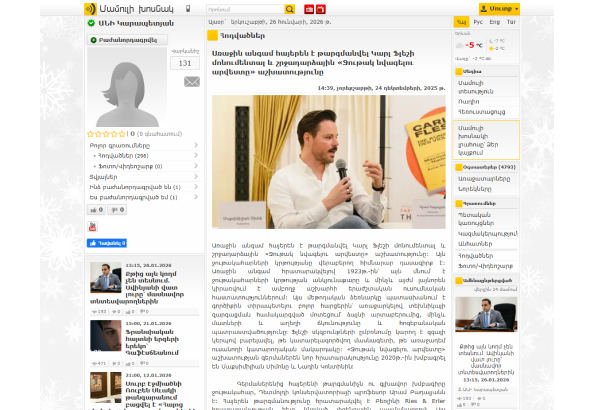
MAMUL.AM: A Book Finds Its Armenian Voice
Mamul.am reports on the Armenian-language release of Carl Flesch’s monumental work “The Art of Violin Playing“, a foundational text for violin education first published in 1923. This work bridges eras, from early 20th‑century performance traditions to today’s young musicians learning their craft in native words.
Read the full Article here
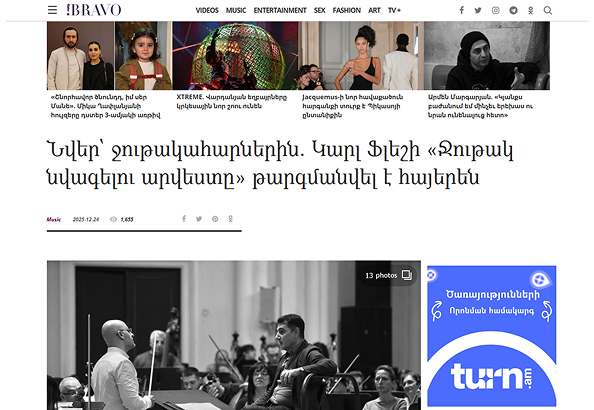
BRAVO.AM: Armenia Marks Landmark Violin Translation with December 24 Concert Featuring Bruch, Korngold, and Glinka
To mark the Armenian translation of Carl Flesch’s The Art of Violin Playing, a concert on December 24 featured Bruch’s Violin Concerto No. 1, Korngold’s Violin Concerto — performed in Armenia for only the second time — and Glinka’s Ruslan and Lyudmila overture. Maximilian Simon, editor of the updated German edition, noted that the book clearly explains the complex techniques every violinist must master. Realized by the Primavera Foundation of Armenia with the Armenian National Philharmonic Orchestra, the project now makes this essential guide accessible to Armenian students and professionals.
Read more here
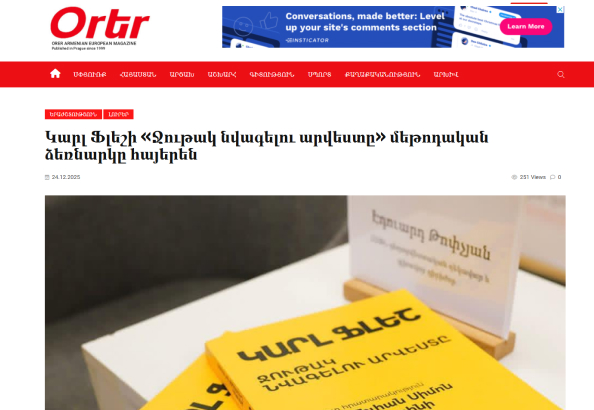
ORER.EU: A century-old violin legacy, now speaking Armenian
For the first time, Carl Flesch’s The Art of Violin Playing is available in Armenian, a milestone for music education in the country. Conductor Eduard Topchyan called it “a wonderful achievement by the Primavera Foundation, led by Elena Yakovleva,” which made this influential violin method accessible to Armenian musicians. He also announced that Flesch’s exercise and scale volume will soon be translated, further bridging generations of musicians.
Explore further here
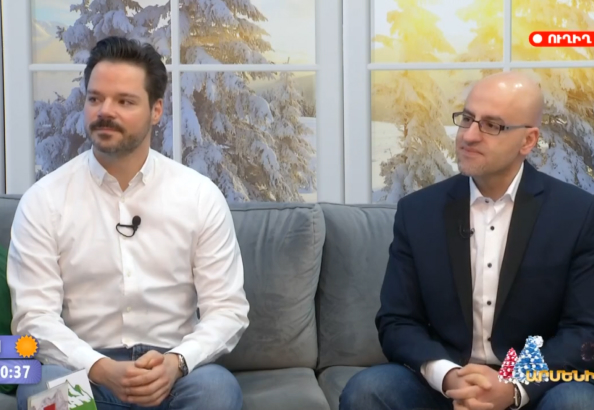
Maximilian Simon and Aram Badalyan Discuss Armenian Translation of Flesch on Armenia TV
Violinists Maximilian Simon and Aram Badalian appeared on Armenia TV to discuss the first Armenian translation of Carl Flesch’s The Art of Violin Playing. Simon modernized the German edition, while Badalian adapted it for Armenian readers, preserving both clarity and technical depth. The 400-page manual, produced by the Primavera Foundation, is freely available to students and professionals, with copies already donated to the Conservatory library.
Watch the full interview here
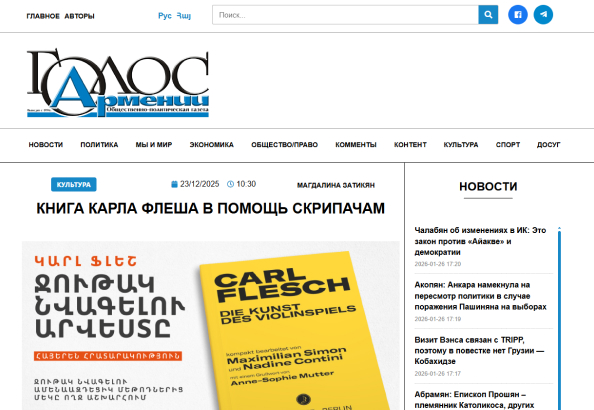
Golos Armenii: Carl Flesch Now Speaks Armenian: A Legendary Violin Method Becomes Accessible in Armenia
Maximilian Simon and Nadine Contini modernized the 2020 German edition of The Art of Violin Playing, while Professor Aram Badalian carefully translated it into Armenian, balancing the beauty of the original German with clarity and practicality for today’s musicians. The project, realized by the Primavera Foundation and the Armenian National Philharmonic Orchestra, marks a milestone for violin education in Armenia.
Read the full Article here

ARMENIA TV: Elevating Musical Dialogue: The Armenian Translation of “ChamberEnsemble Toolkit” is Here
The Primavera Cultural and Charitable Foundation has published the first Armenian translation of “Chamber Ensemble Toolkit” a textbook by Professor Irina Krasotina that serves as a bridge between musical theory and practical collaboration. This milestone addresses the critical lack of professional music literature in the national language, offering students and teachers a specialized methodology for developing ensemble thinking and creative partnership. Translated by Nona Voskanyan and edited by Gayane Hovhannisyan, the work preserves the prestigious traditions of the Moscow Conservatory while incorporating modern pedagogical standards. The manual is being distributed free of charge to applicants via the foundation’s official website to support the growth of the Armenian musical community.
Watch the video here

Bari Luys: Yelena Yakovleva Presents Armenian Edition of Carl Flesch’s The Art of Violin Playing
On the Bari Luys show, Yelena Yakovleva, co-founder and executive director of the Primavera Foundation of Armenia, introduced the first Armenian translation of Carl Flesch’s The Art of Violin Playing. The book will be provided free to conservatories, music colleges, and schools, and its release was celebrated with a concert featuring Maximilian Simon and Aram Badalian with the National Philharmonic Orchestra under Eduard Topchyan.
Watch the full video here
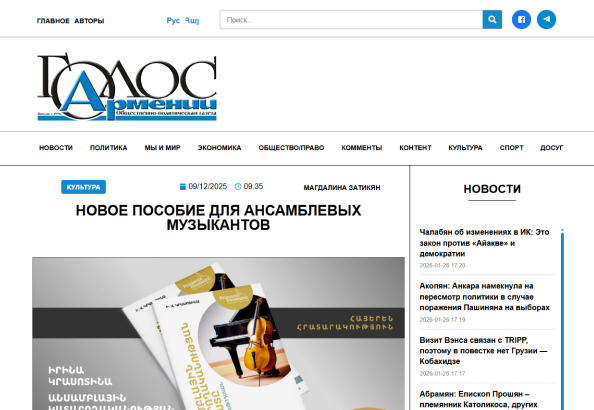
Golos Armenii: New Armenian Edition Expands Resources for Ensemble Musicians
An Armenian translation of Professor Irina Krasotina’s ensemble performance manual has been published, offering a two-part study on collaborative musicianship and musical text analysis. Created with the participation of Yerevan State Conservatory experts, the book reflects the author’s long-standing teaching experience. The release adds a rare and valuable resource to Armenian-language music education.
Explore further here
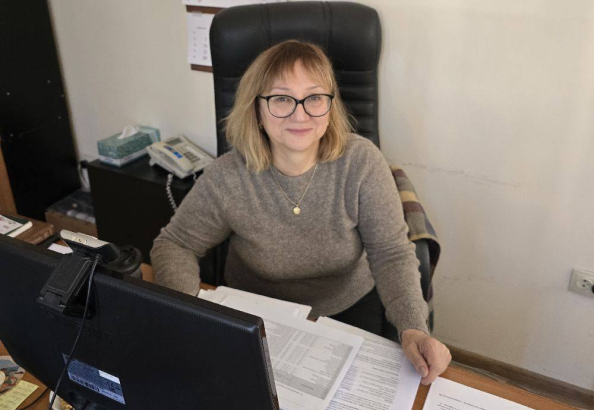
Медиа как пространство культуры
Интервью с генеральным директором «Новости-Армения» Галиной Давидян о роли СМИ в формировании общественного сознания и поддержке культурных инициатив в рамках спецпроекта об армянском издании книги Карла Флеша.
Հարցազրույցն ամբողջությամբ ՝ այստեղ
Фокус на человеке, мультимедиа и динамика: как создавать пространство для культурных инициатив по версии «Новости-Армения»
Сегодня СМИ продолжают оставаться институтом, который, с одной стороны, генерирует общественные интересы и представления о стандартах, а с другой – транслирует новые правила и ценности. Какую роль в формировании общественного сознания играют СМИ, с какими сталкиваются трудностями при освещении культурных и социальных вопросов и как сегодня можно стимулировать интерес общества к культурным и социальным инициативам? Ответы на эти вопросы в интервью генерального директора агентства «Новости-Армения» Галины Давидян с Primavera Foundation Armenia.
— Как Агентство международной информации «Новости-Армения» видит роль СМИ в формировании общественного сознания и поддержке культурных и социальных инициатив?
— СМИ, безусловно, играют ключевую роль в формировании общественного сознания. Выбирая темы и акцентируя внимание людей на конкретных аспектах, СМИ диктуют определенную культурную норму: могут способствовать укоренению в обществе определенных культурных ценностей, а могут и выступать за перемены. Но в любом случае они обязаны беречь художественное наследие, поддерживать социальные проекты и способствовать формированию более зрелой общественной среды. Именно в таких темах проявляется ценность журналистики как института. То есть не просто информировать, а помогать аудитории видеть ценность культурных и общественных процессов.
В продолжение темы отмечу, что агентство «Новости-Армения» создаёт пространство, где культурные и социальные проекты становятся понятнее и эмоционально значимее.
Мы стремимся к тому, чтобы каждая история работала не только на осведомлённость, но и на укрепление общественного диалога и повышение интереса к культуре.
— Могли бы вы привести пример культурного или социального проекта, освещение которого в СМИ оказало значительное влияние. Были ли неудачи и каковы их причины?
Очень эффективной оказалась наша интерактивная игра «Готовы ли вы к “Ночи музеев”?», где пользователи угадывали картины армянских художников. Она невероятно быстро распространилась, оказалась необычайно эффективным инструментом популяризации искусства и привлечения большого потока посетителей в музеи, причем даже тех, кто обычно далёк от музейной среды.
Существенную общественную роль сыграли и наши проекты периода пандемии — «Антикоронавирус» и «SaveBusiness». Первый снижал тревожность в обществе, предоставляя проверенную информацию, второй помогал предпринимателям адаптироваться к новым условиям и находить решения в критической ситуации. Эти инициативы стали своеобразными опорными точками в нестабильное время.
За годы своей деятельности мы всегда стремились вводить новые стандарты, ломать стереотипы. Так, в канун очередного дня рождения агентства мы призвали наших читателей направить помощь тем, кто в этом наиболее остро нуждается — беженцам из Арцаха и детям. Мы объяснили это тем, что такой их шаг был бы лучшим подарком для нас. Перечислять свои средства можно было в благотворительные фонды “Вива” и “Дорога жизни”. Как нам позже сообщили из фондов, многие граждане начали делать пожертвования сразу после нашей публикации.
Отличный резонанс получила также совместная с Америабанком инициатива по продвижению социального и благотворительного проекта, направленного на поддержку программ будущего в Армении. В рамках кампании Америабанк выделил 100 млн. драмов на развитие значимых инициатив (помощь детям, образование, наука, «зеленая экономика», технологии, МСБ, спорт). При этом решить, куда распределять средства, должны были сами пользователи через онлайн-голосование. Вскоре выяснилось, что люди необычайно активно откликнулись на инициативу банка и массово включились в этот процесс.
Примечательно, что в ходе осуществления этого проекта агентство впервые использовало инновационный формат в виде коротких информативных обзоров – Shortreads. Он стал одним из ключевых инновационных направлений агентства и был признан лучшим цифровым проектом 2025 года на конкурсе Armenia Digital Awards 2025.
Что касается неудач, то они чаще возникали там, где авторы проектов приходили к медиа слишком поздно: пбез бюджета, без сформированной коммуникационной стратегии и регулярности подачи материалов.
— С какими трудностями сталкиваются СМИ при ответственном освещении культурных и социальных вопросов, и как «Новости-Армения» их решает?
Самая сложная задача — сохранять осторожность при освещении таких тем. Культурная и социальная повестка требует особой точности. Это темы, чувствительные к нюансам: личным, историческим, ценностным. Мы придерживаемся принципа «бережной журналистики»: опираемся на верификацию данных, консультируемся с экспертами, находимся на постоянной связи с инициаторами проектов.
Дополнительная сложность еще и в том, что многие инициативы не располагают современными коммуникационными инструментами, качественным контентом или PR-поддержкой. В таких случаях мы берем на себя роль медиапартнёра: помогаем структурировать материалы, уточнять данные, формируем нужный формат, что делает проект заметным и понятным аудитории. Для нас это не только часть работы, но и вклад в культурную экосистему страны.
— Насколько аудитория заинтересована в социальных и культурных инициативах и какие стратегии эффективны для повышения интереса?
Как показывает наш опыт, аудитория активно откликается на такие инициативы, если они поданы современно, эмоционально и с уважением к человеку. Мы видим это по реакции на спецпроекты, тесты, видео и материалы, основанные на личных историях, где есть живое переживание.
Для того, чтобы повысить интерес к таким инициативам необходимо фокусироваться на человеческом опыте и живых эмоциях; использовать мультимедийный подход, а это — видео, визуальные подборки, интерактивы. Также надо обеспечить регулярность и последовательность материалов, а не ограничиваться одноразовой публикацией. И, разумеется, непременно партнерствовать с музеями, фондами и культурными организациями.
Когда культурный или социальный контент подан уважительно, современно и интересно, он сам формирует аудиторию вокруг себя. Задача медиа — поддерживать этот интерес и усиливать инициативы, которые делают общество более осознанным и открытым.
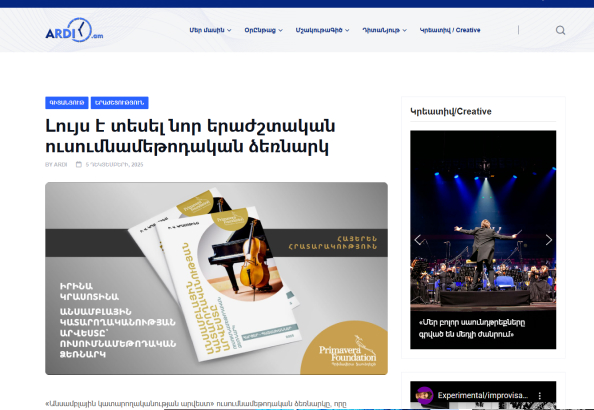
ARDI: Comprehensive Ensemble Music Guide Published in Armenian
The Armenian translation of The Art of Ensemble Performance by Professor Irina Krasotina has been released. The manual serves as a practical and methodological guide for teachers and students, covering ensemble performance techniques, rehearsal strategies, and musical interpretation. Copies will be distributed free of charge to secondary and higher music schools in Armenia.
Explore the full Article here
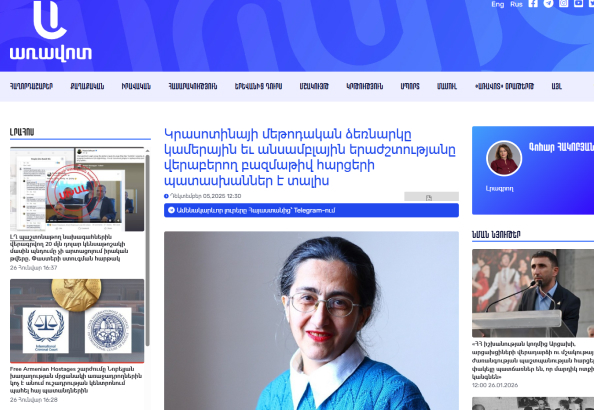
ARAVOT DAYLY: Interview with Professor Gayane Hovhannisyan
ARAVOT DAYLY: Krasotina’s Manual Answers Key Questions in Chamber and Ensemble Music
Professor Irina Krasotina’s methodical manual, The Art of Ensemble Performance, provides comprehensive guidance for both teachers and students in Armenia. The book addresses various aspects of chamber and ensemble music, including repertoire selection, rehearsal techniques, and musical expression. It is designed to enhance understanding and performance quality, and copies are distributed free of charge to Armenian music schools and institutions.
Read the full Article here
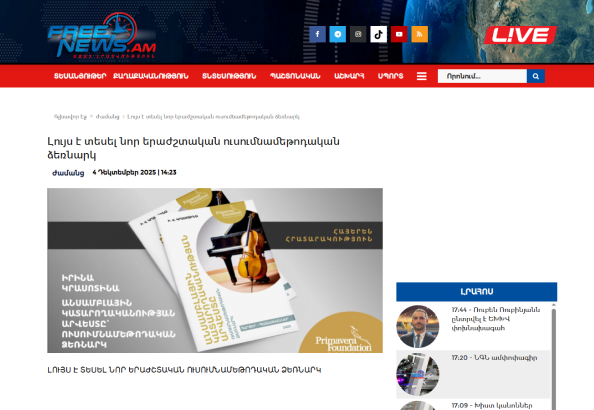
FREE NEWS: New Methodological Guide for Music Education
An Armenian edition of Irina Krasotina’s methodological work on ensemble performance has been released, presenting modern approaches to chamber music training. The guide focuses on developing ensemble thinking, collaborative interpretation, and conscious score reading. It is intended to support both students and professionals by strengthening the culture of musical collaboration.
Read the full Article here
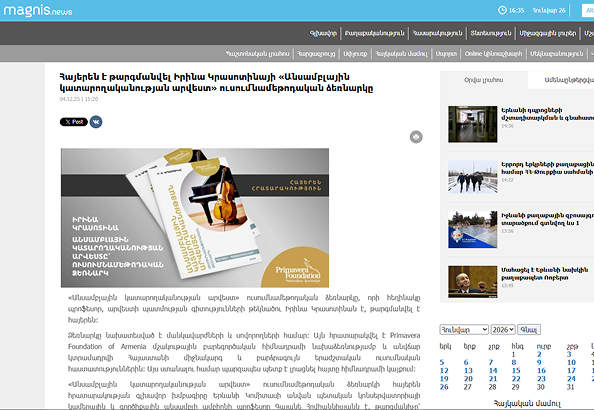
MAGNIS.AM: Armenian Edition Highlights the Value of Chamber Music Collaboration
The Armenian translation of Irina Krasotina’s methodological work places special emphasis on ensemble interaction as a core professional skill for musicians. Drawing on classical performance traditions and modern pedagogy, the manual examines how collective interpretation shapes artistic outcomes. The publication reflects years of close cooperation between Krasotina and Armenian music institutions. Its release strengthens the academic foundation of chamber music studies in Armenia.
Read the full Article here
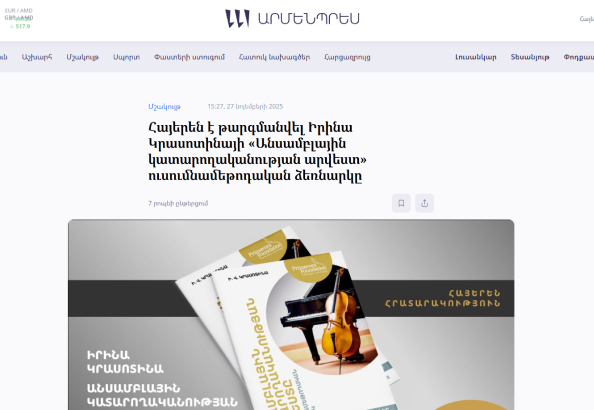
ARMENPRESS: Irina Krasotina’s “Chamber Ensemble Toolkit” Now Available in Armenian
The teaching manual Chamber Ensemble Toolkit by Professor Irina Krasotina has been translated into Armenian and published by the Primavera Foundation of Armenia. It will be provided free to music schools, colleges, and conservatories. The manual offers practical guidance on ensemble playing, repertoire selection, rehearsals, and musical interpretation, combining Krasotina’s personal experience with established traditions.
Read the full Article here
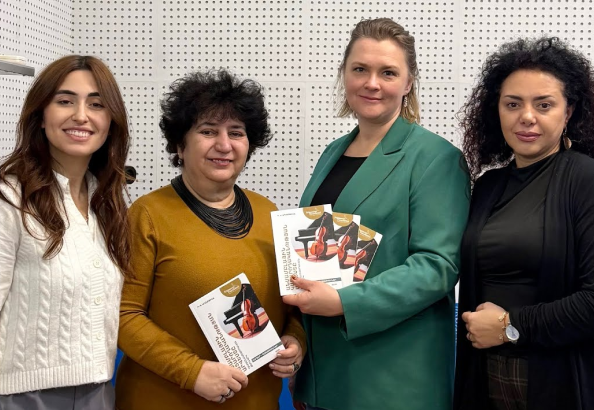
Public Radio of Armenia: About Chamber Ensemble Toolkit – Armenian Edition
On November 25, Nona Voskanyan, translator of the Armenian edition of Irina Krasotina’s Chamber Ensemble Toolkit and musicologist, together with, Primavera Foundation CEO and Co-founder Elena Yakovleva, were guests on Public Radio of Armenia. They spoke about the significance of publishing the toolkit in Armenian, its role in supporting young musicians, and the special features that make it a valuable resource for chamber music education.
Watch the full video on our Youtube channel.
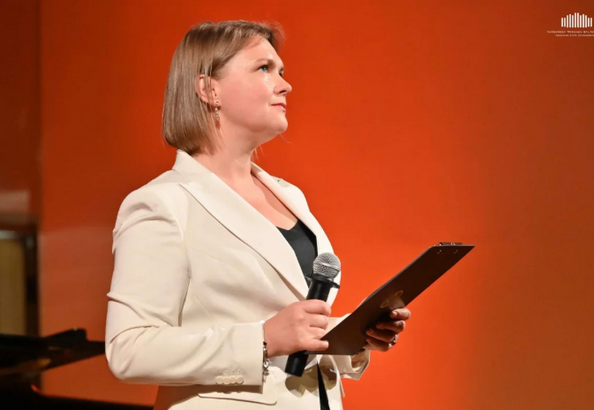
Lessons from Armenia: Elena Yakovleva
Read this article by Naré Bedzhanyan about Elena Yakovleva, co-founder of the Primavera Foundation, who advances classical music in Armenia through educational programs, concerts, publishing, and international collaborations, while showcasing the warmth and resilience of the Armenian people.